Features
Everything it does, and what it costs you to run
GameHydra is a tray application that manages where your Steam games physically live. It is not a launcher, not a cleaner, and not something you interact with daily.
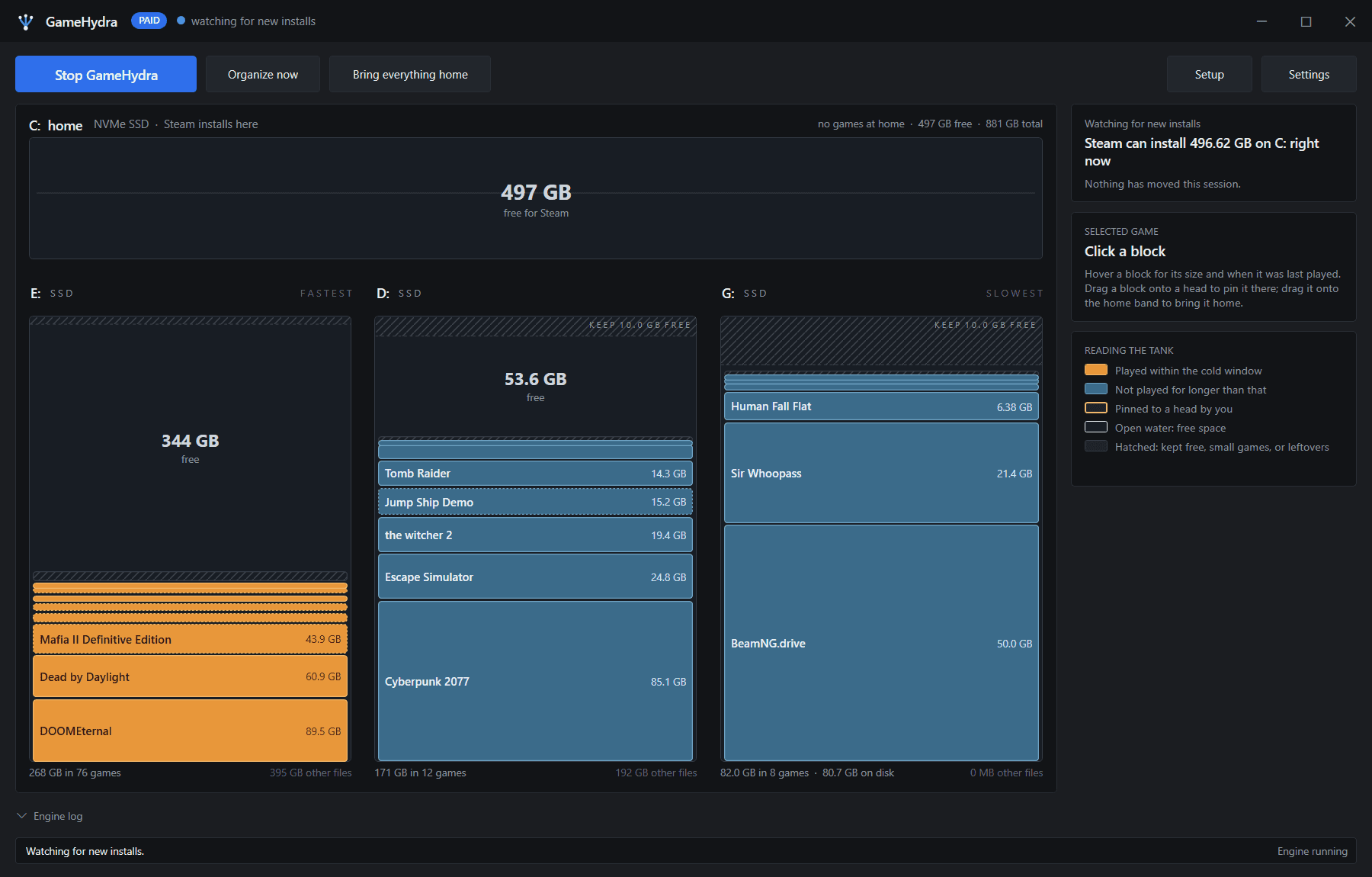
- Played within the cold window
- Not played for longer than that
- Pinned to a drive by you
- Free space
- Paid
Games sort themselves
New downloads are moved off the Steam drive as they finish, without you clicking anything.
GameHydra watches your Steam libraries. When a download finishes, the game is moved to the right drive and a junction is left behind. You do not open the app, and you do not pick a destination. On the Free tier the same sorting runs when you click Organize now.
Fast drives for what you play
Recently played games sit on your fastest included drive. Games gone cold drift to the slowest.
You tell GameHydra which drives it may use and how fast each one is. Games you have played recently stay on the quickest drive with room for them. Games you have not opened in a while move down to slower storage. A game is only ever moved whole — never split across drives, never partially copied.
Steam never notices
An NTFS junction stays where the game was, so the path Steam recorded still resolves.
The game folder moves; a junction takes its place at the original path. Windows resolves it below the file-system API, so Steam, the launcher and the game itself all read the old path and get the new location. Launching works. Updates work. Uninstalling from Steam works. Verifying game files works.
- Paid
Compression for cold games
Games you have not played in a while are compressed in place, and decompressed when you launch them.
Cold games can be compressed with LZX, the compression built into Windows. The game stays where it is and stays playable — Windows decompresses on read. GameHydra fully decompresses a game the moment you launch it again, so there is no first-run penalty after the initial restore.
Runs in the tray
Starts with Windows and stays out of the way. There is no daily interaction.
GameHydra sits in the system tray and starts with Windows. Day to day you do not open it. When you do, it shows which drive every game is on, how much space each drive has, and what it plans to move next.
Never moves a game you are using
Nothing moves while a game is running, while Steam is downloading, or while you are in the app.
A move is deferred if the game is running, if Steam is mid-download or mid-update, or if you are actively using GameHydra. Moves are whole-game, so an interrupted move leaves the game where it started rather than half-copied.
One-click undo
Bring everything home restores every game to its own drive and removes every junction.
One action moves every game back where Steam originally put it and removes the junctions. It runs automatically before you uninstall GameHydra, so removing the app leaves your libraries exactly as it found them. Nothing depends on GameHydra still being installed.
Override it when you want to
Drag a game onto a drive to pin it there, and the sorter leaves it alone.
The automatic placement is a default, not a rule. Drag a game block onto a drive to pin it there and it stays put regardless of how long since you played it. Drag it onto the home band to bring that one game back to the Steam drive. Pinned games are outlined so you can see at a glance what you have overridden.
Leaves room on every drive
Each drive keeps a reserve free, so a drive never fills to the point of causing problems.
You set an amount to keep free on each included drive — 10 GB by default. GameHydra treats that as unavailable and will not pack a game into it. Small games and leftovers are shown against the same reserve, so what you see as free space really is free.
- Paid
As many drives as you have
Add every HDD and secondary SSD in the machine. GameHydra fills them in order.
Include any drive you want used, and set its speed. The Free tier manages one included drive; Paid removes that limit. Drives can be excluded at any time, and excluding one moves its games elsewhere rather than stranding them.
Launcher support
Steam works. The others do not yet.
The app has a picker listing these because that is where support will appear. Only Steam is built. If your games are somewhere else, wait for the one you need.
- Steamsupported
- Epic Gamesnot yet
- Ubisoft Connectnot yet
- EA Appnot yet
- GOG Galaxynot yet
- Xbox PCnot yet
Requirements
What it needs
The NTFS requirement is not a preference. Junctions are an NTFS feature, so a non-NTFS drive cannot be a destination.
- Operating system
- Windows 10 or 11, 64-bit
- File system
- NTFS on both the source and destination drives
- Permissions
- Administrator, once, to create junctions
- Storage
- One or more additional internal or external drives
- Launchers
- Steam. Other launchers are on the roadmap.
- Junctions are an NTFS feature. Both the drive Steam installs to and the drive a game moves to must be NTFS. exFAT and FAT32 drives cannot be used as destinations.
- Network drives and mapped network locations are not supported. Junctions do not resolve reliably across them.
Scope
What GameHydra is not
Being clear about this saves you a download.
Not a launcher
You still launch games from Steam. GameHydra has no game list you play from and no overlay.
Not a disk cleaner
It does not delete anything, find junk files, or reclaim space by removing data. It moves whole games and leaves them intact.
Not a backup tool
A moved game exists in one place, on one drive. Compression saves space; it is not a second copy.
Stop uninstalling games to make room.
The free tier manages your Steam library across one extra drive. If it earns its place, the paid unlock is $9.99, once.