A Byte Size Factory product · Windows 10 and 11
Your Steam drive is full. Your other drives are not.
GameHydra moves whole games onto your other drives and leaves an NTFS junction behind. Steam still finds them, they still launch and update, and your install drive keeps the free space it needs for the next download.
Free tier manages Steam on one drive · Paid is $9.99 once · Windows 10 and 11
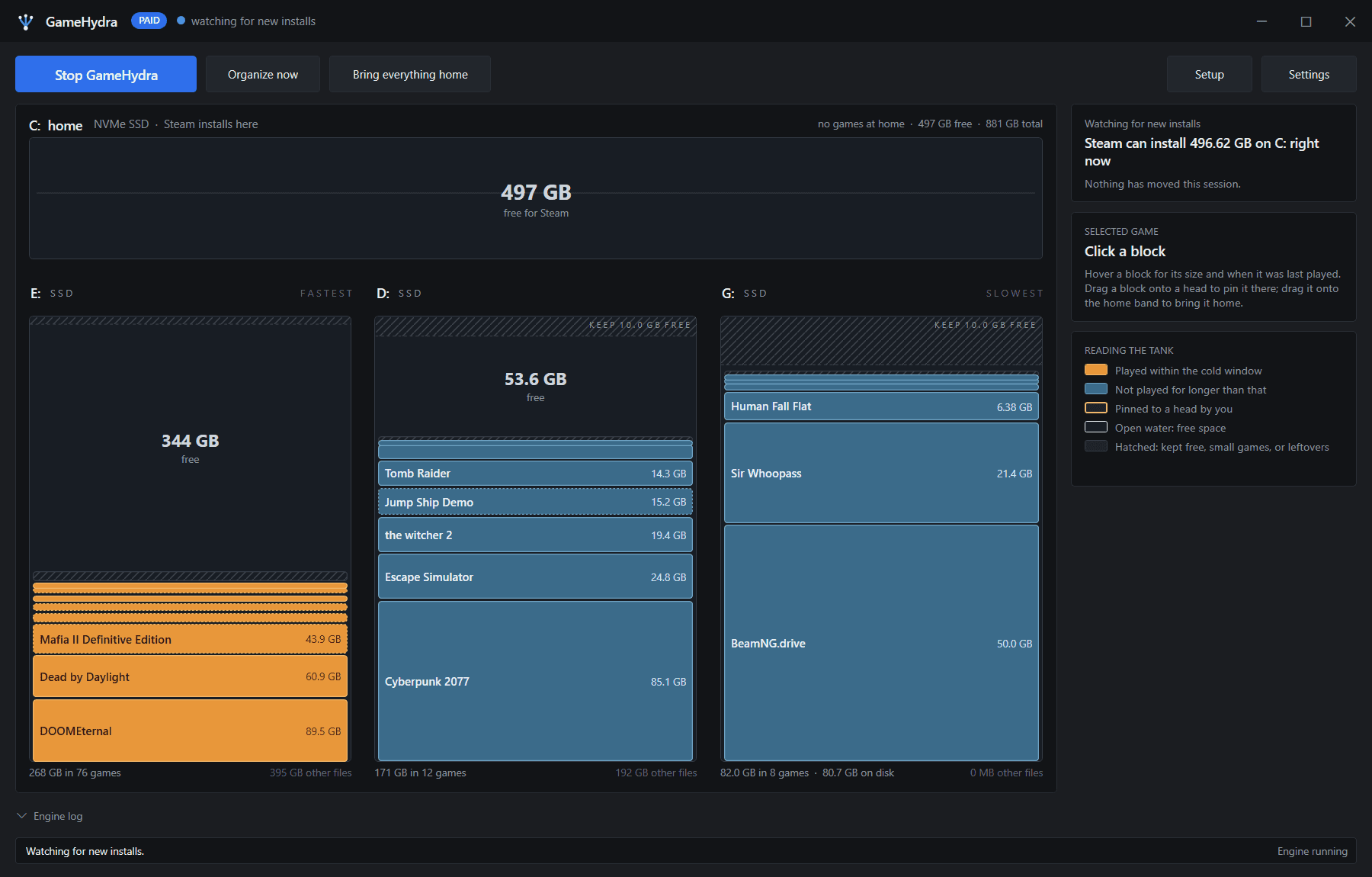
- Played within the cold window
- Not played for longer than that
- Pinned to a drive by you
- Free space
The problem
Steam checks one number before it lets you install.
Free space on the install drive. When that runs out, the next download will not start, and the usual fix is uninstalling something you still want. Meanwhile the other drives in the machine sit half empty, because moving a game there means telling Steam about it and doing it one game at a time.
GameHydra keeps that number high without you managing anything.
What Steam opens
C:\Steam\steamapps\common\SomeGame\Unchanged. This is the path Steam recorded at install time and the only one it uses.
NTFS junction
Where the files are
D:\GameHydra\SomeGame\The whole game, on the drive that suits how recently you played it. Never split, never partially moved.
How it works
Move the folder. Leave a link.
Four steps, no configuration to speak of, and nothing Steam can tell happened.
- 1
Steam records a path when it installs a game
A game installed to your main library lives in a folder inside steamapps\common. Steam stores that path and uses it for launching, updating and verifying. Everything Steam does with the game goes through that one location.
- 2
GameHydra moves the folder to another drive
The whole game folder is copied to an included drive, verified, and only then removed from the original location. A game is never split between drives and never left half-moved — if the copy is interrupted, the original stays exactly where it was.
- 3
A junction takes its place
An NTFS junction is created at the original path, pointing at the new one. A junction is a directory-level link that Windows resolves inside the file system itself, below the level any application sees.
- 4
Steam reads the old path and gets the new drive
Steam opens the path it recorded. Windows follows the junction and returns files from the other drive. Steam does not know a junction is involved, because nothing in the file API tells it. Launching, updating, verifying and uninstalling all behave normally.
What it does
Set it up once, then forget it exists
It lives in the tray, starts with Windows, and sorts games as they finish downloading.
- Paid
Games sort themselves
New downloads are moved off the Steam drive as they finish, without you clicking anything.
Fast drives for what you play
Recently played games sit on your fastest included drive. Games gone cold drift to the slowest.
Steam never notices
An NTFS junction stays where the game was, so the path Steam recorded still resolves.
- Paid
Compression for cold games
Games you have not played in a while are compressed in place, and decompressed when you launch them.
Never moves a game you are using
Nothing moves while a game is running, while Steam is downloading, or while you are in the app.
One-click undo
Bring everything home restores every game to its own drive and removes every junction.
Steam today. The rest are being built.
GameHydra manages Steam libraries. The app lists the other launchers so you can see what is planned, but those integrations are not finished — if Steam is not where your games are, this will not help you yet. Paid covers every launcher as it ships.
- Steamsupported
- Epic Gamesnot yet
- Ubisoft Connectnot yet
- EA Appnot yet
- GOG Galaxynot yet
- Xbox PCnot yet
The product
One app, one purchase, your drives
No account required to use it, and no server on our side your games depend on. The licence you buy keeps working on the version you bought.
GameHydra
Your Steam drive, kept clear by your other drives.
GameHydra moves games off your Steam drive onto your other drives and leaves a link behind, so Steam still finds them and your install drive keeps its free space.
- Free tier
- Steam, 1 drive
- Paid
- $9.99once
- Platform
- Windows
- Launchers
- Steamtoday
- Whole-game moves, never split
- NTFS junctions — Steam sees no change
- Sorts by how recently you played
- One click to bring everything home
Steam only for now. Other launchers unlock on Paid as they ship.
Pricing
Free to try properly. $9.99 to automate it.
The free tier is not a trial — it manages Steam across one drive for as long as you want. Paid removes the drive limit and does the sorting for you. Compare the tiers.
Free
Steam, one drive, whenever you say so.
Free
Download free- Manages your Steam library
- One included drive
- Whole-game moves with NTFS junctions
- Bring everything home in one action
- Runs in the tray, starts with Windows
- Automatic sorting — you click Organize now
- More than one included drive
- Cold-storage compression
- Other launchers as they ship
Recommended
Paid
Set it up once and stop thinking about drive space.
$9.99one-time
Buy for $9.99- Everything in Free
- Automatic sorting — games move themselves as downloads finish
- Unlimited included drives
- Cold-storage compression with Windows LZX
- Pin a game to a drive to override the sorter
- Every launcher unlocked as support ships(not yet available)
- One-time purchase
One-time purchase. Activation needs the internet once, then works offline.
Questions
The ones that decide it
Will Steam notice?
No. A junction is resolved by Windows inside the file system, below the level any application can see. Steam opens the path it recorded and gets the files from the other drive. Launching, updating, verifying game files and uninstalling from Steam all work exactly as before, because as far as Steam is concerned nothing changed.
What happens if I uninstall GameHydra?
Every game is brought home first. Uninstalling runs Bring everything home automatically: each game is moved back to its original drive and every junction is removed. Your libraries end up exactly as GameHydra found them. Nothing keeps working only because the app is installed.
What if I unplug a drive?
The games on that drive become unavailable until you plug it back in, in the same way they would if you had installed them there directly. The junction remains and resolves again as soon as the drive returns. GameHydra will not move new games onto a drive it cannot see, and it flags any game whose drive is missing rather than letting Steam fail silently.
Is my data safe?
A game is copied to its new drive and verified before the original is removed, so an interrupted move leaves the game intact where it started. Games are only ever moved whole, never split across drives. Nothing moves while a game is running or while Steam is downloading. GameHydra moves game installs — it does not touch save files, which Steam keeps elsewhere.
Stop uninstalling games to make room.
The free tier manages your Steam library across one extra drive. If it earns its place, the paid unlock is $9.99, once.